The Waist Gap in Leggings: Why It Happens and What Actually Closes It
Quick Answer: A gap at the back of the waistband happens when your waist-to-hip difference is larger than the pattern assumes - the leggings fit your hips and are too big at your waist. Sizing down does not fix it; it makes the hips too tight while the waist still gaps. What works is a contoured or V-shaped waistband, a curvy-specific fit line, a drawcord, or a higher rise that sits at the narrowest point.
You size for your hips, and there is a handspan of empty space at the small of your back.
You size down, and now the hips are painted on and the gap is still there. That is not you doing it wrong - that is the pattern doing something it cannot do.
Why does the gap exist at all?
It is a geometry problem between two measurements.
Every legging pattern assumes a specific relationship between waist and hip circumference. Standard patterns typically assume a difference somewhere around 25-30cm - the number varies by brand, and almost none publish it.
If your waist-to-hip difference is larger than the assumption, the leggings that fit your hips are too big at your waist. The excess fabric has to go somewhere, and it goes to the back, because the front is held closed by the abdomen while the back curves inward at the small of the spine.
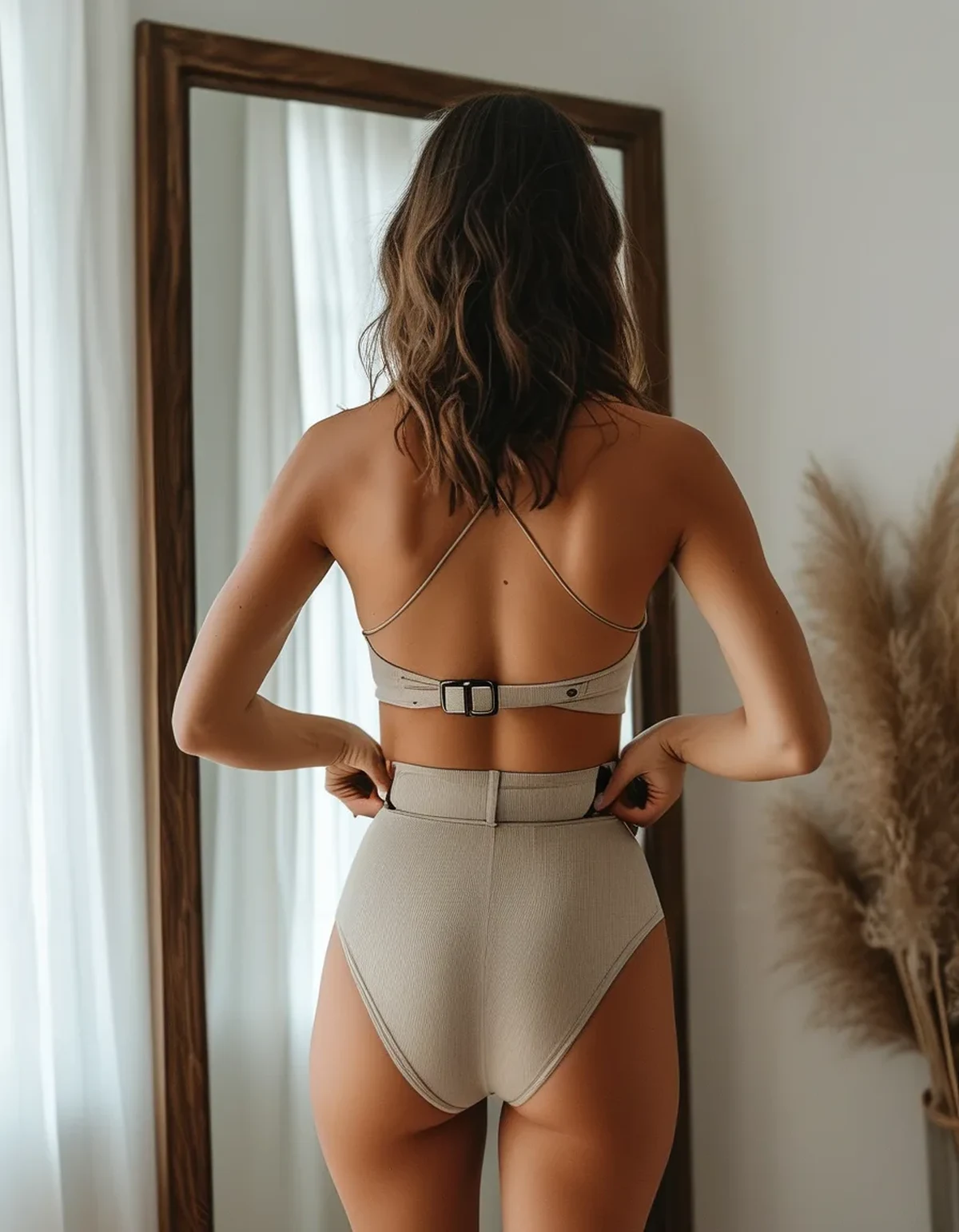
Why the back specifically: the lumbar curve creates a hollow. A straight-cut waistband is a cylinder. A cylinder cannot follow a concave curve, so it bridges across it, and the bridge is the gap.
Which is why sizing down fails. The waist and hip are graded together. Going down a size reduces both by roughly the same proportion, so the ratio stays the same and the gap persists while the hips become too tight. You have changed the size, not the shape.
Two practical consequences worth knowing:
- The gap is a pattern-fit mismatch, not a body problem - it tells you the brand drafted for a different ratio
- Some brands do publish their fit assumptions or offer curvy-specific lines, and those are the ones worth finding
The seasonal aggravation: the gap is most annoying in warm weather, because a gap that scoops air in a cold gym is merely draughty, while in humid conditions it means the waistband slides more as you sweat.
What actually closes the gap?
Four approaches, ranked by how reliably they work.
1. A contoured or V-shaped waistband. The most effective structural fix. A waistband that is cut higher at the back and dips at the front, or one that is shaped rather than straight, follows the lumbar curve instead of bridging it. Brands describe this as contoured, V-back, or curved waistband. If a legging is described that way, it is worth trying.
2. A curvy or shaped fit line. Some brands draft a separate pattern with a larger waist-to-hip difference. These are usually labelled explicitly. When they exist, they solve the problem at source and no styling workaround is required.
3. A drawcord or adjustable waistband. Genuinely effective, and often dismissed as unsophisticated. An internal drawcord lets you close the waist independently of the hip. The trade-off is a knot under fitted tops, which matters or does not depending on what you wear.
4. A higher rise. Counterintuitive, and it often works. A higher rise sits at the natural waist, which is the narrowest point and where the circumference difference is most pronounced - but crucially, it also sits above the lumbar hollow. The band ends up on a more cylindrical part of the torso, and gaps less.
A fifth partial fix: wide elastic with high recovery. A band with strong recovery pulls in more at the waist than a soft one, closing a small gap. It will not close a large one, and pushing a soft band to do it just produces rolling.

What makes it worse?
Two common responses, both intuitive and both wrong.
Sizing down. Covered above, and worth repeating because it is nearly universal. The waist and hip grade together, so the ratio is unchanged. You get tight hips, a visible strain line across the thigh, and the same gap. Additionally, over-stretched fabric goes sheer, so the squat-proofing degrades too.
Adding a belt or clip. A clip pulls the band into a pleat, which creates a bulk point rather than distributing the excess. It also concentrates all the tension at one spot, which produces digging on either side of the clip and pulls the whole waistband down asymmetrically.
Two further things that quietly make it worse:
Wearing the band too low. A high-rise band worn at the hip sits directly across the lumbar hollow at its deepest point. Pulling it up to the natural waist often halves the gap immediately, at no cost.
A stretched-out waistband. Elastic loses recovery with heat. A band that has been through hot washes and tumble drying will gap more than it did new. Cold wash and air dry preserves recovery, and a band that has gone is not recoverable.
One more worth flagging: loaded side pockets. A phone in a side pocket drags that side of the waistband down, which opens the gap on the opposite side. If your gap appeared recently and you started carrying your phone in the legging, that is a plausible cause.
Myth vs Fact: The Waist Gap
Myth: A gap means you bought the wrong size. Fact: It means the pattern’s waist-to-hip ratio does not match yours. The size is probably correct for your hips, which is the measurement that determines fit through the leg.
Myth: Compression leggings will not gap. Fact: Compression affects how tightly fabric grips, not the shape of the pattern. A compressive legging drafted on the same ratio gaps the same way, and grips harder at the hips while doing it.
Myth: A higher rise will gap more. Fact: Usually the opposite. A higher band sits above the deepest part of the lumbar hollow, on a more cylindrical section of torso, and often gaps less than a mid-rise.
Myth: The gap is unavoidable if you have a small waist. Fact: Contoured waistbands and curvy-specific fit lines exist precisely for this, and they work. It is a solved problem in patternmaking that not every brand chooses to solve.
Myth: Sizing down at least makes the waist fit. Fact: It reduces both measurements proportionally, so the gap remains while the hips become too tight. It is the change that feels most logical and delivers least.
FAQ: Waist Gap Questions, Answered
Can a tailor fix a gap in leggings?
Sometimes, for a small gap - a seamstress can take in the centre back of the waistband. On heavily stretchy technical fabric it is fiddly, and it can affect how the band recovers. For an expensive pair it may be worth it; for most, finding a contoured band is easier.
Does the gap mean the leggings will slide down?
Often, yes - the gap means the waist is not being gripped, so the band relies entirely on the hips to stay up. That is why gapping and sliding usually appear together, and why fixing the gap generally fixes the sliding.
Which style should I look for first?
Contoured or V-back waistband, in your normal hip size. If a brand offers a curvy-specific line, start there. Both address the ratio rather than the size.
Why do some brands never gap on me?
Because their pattern assumes a waist-to-hip ratio closer to yours. It is worth noting which brands those are - the fit assumption is consistent across their whole range, so one good fit usually predicts more.
Will a drawcord look obvious?
Under a loose or mid-weight top, no. Under a thin fitted top, the knot can show slightly. Tucking the cord ends inside the waistband handles most of it, and the trade-off is often worth the fit improvement.
TL;DR:
- A back waist gap means the pattern’s waist-to-hip ratio is smaller than yours, not that you bought the wrong size
- Sizing down keeps the ratio identical - you get tight hips and the same gap
- Contoured or V-back waistbands follow the lumbar curve instead of bridging it
- Curvy-specific fit lines solve it at the pattern level when brands offer them
- A higher rise often gaps less, because it sits above the deepest part of the lumbar hollow
- Belts and clips create a pleat and a pressure point rather than distributing the excess
The gap is information about the pattern. Once you know which brands draft for your ratio, it stops being a recurring problem.
See It in Motion
Seen here: High Waist Yoga Leggings with Inner Pocket — shop it on bubblelime.com
Keep Reading
This article is for general informational and styling purposes only. Fit, sizing, and product availability may vary.