The Back Gap: When Leggings Fit Your Hips but Gape at Your Waist
Quick Answer: The back gap happens because most leggings are graded for a 10-inch difference between waist and hip, and many curvy bodies carry 12 to 15. Size for your hips - correctly - and the waistband has extra circumference with nowhere to go, so it stands away from the small of your back and yawns open when you sit or squat. The fixes: buy for construction (contoured waistbands, internal drawcords, higher rises with wide bands), test with a sit-and-bend before committing, and for pairs you already love, a tailor can take in a waistband for less than the price of new leggings.
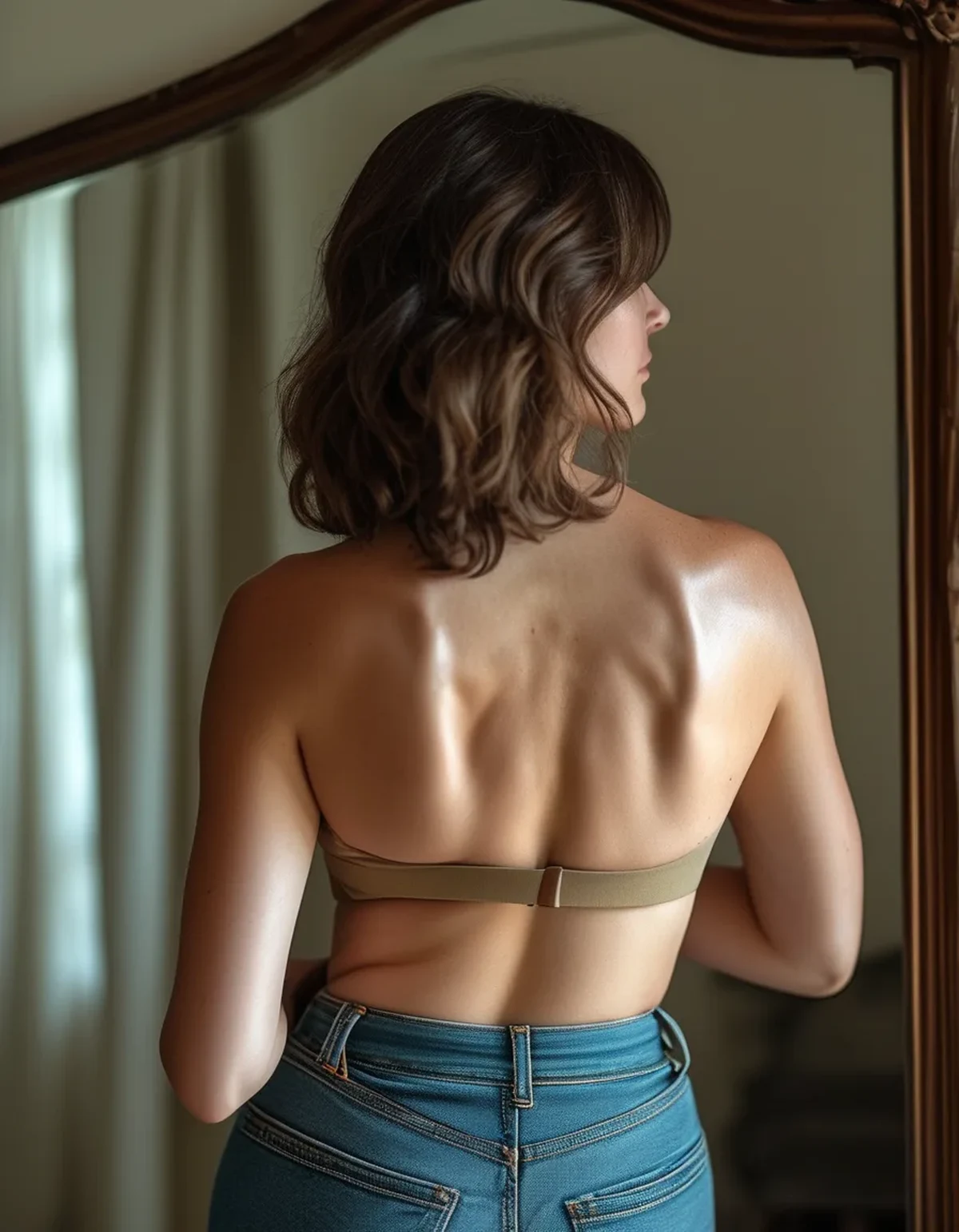
It is the most universal curvy fitting-room moment there is: the pair that glides over your hips, fits your thighs like it was poured, looks incredible from the front - and gapes two inches off your spine the moment you sit down. Nothing about your body is wrong. A piece of standardized geometry is wrong, and once you can see the geometry, you can beat it.
Why does the gap happen in the first place?
Because clothing is built on an average ratio, and ratios are where averages fail hardest.
Every legging is drafted around a waist-to-hip drop. Pattern grading typically assumes the hip measures about 10 inches more than the waist, and every size up or down moves both numbers together, keeping that ratio fixed. A body with a 13-inch drop does not fit anywhere on that chart: the size that matches your hips has a waist opening built for someone two-plus inches bigger through the middle than you are.
Stretch fabric hides the problem everywhere except the back. Elastane happily spans the extra circumference through the seat and thighs - that is what it is for. But at the waist, excess circumference cannot stretch away; it can only stand off the body. And it stands off at the back specifically because of posture: the small of the back curves inward, the waistband bridges straight across that curve like a chord across an arc, and the deeper your lumbar curve, the wider the bridge.
Movement turns a gap into a canyon. Sitting and squatting rotate the pelvis and deepen the low-back curve while the hips widen into the fabric - the band gets pushed away from the spine at the exact moment it most needs to stay anchored. This is why a pair that seems fine standing in the fitting room betrays you at your desk by 10am.
And sizing down does not fix it - it just relocates the problem. Drop a size and the waist gap shrinks while the fabric over your hips and thighs goes past its comfortable stretch: compression lines, a waistband that folds itself down under tension, sheerness over the seat in a deep squat. You traded a gap for three worse problems. The answer was never a different size on the same chart - it is a different chart, or a different construction.
What should you actually buy? Construction beats size
Four construction features close the gap at the checkout, before any tailoring is needed.
A contoured waistband. Look for bands cut as curved pieces - often visible as a V-shaped or angled back seam - rather than one straight tube of fabric folded over. A contoured band is drafted shorter along its top edge than its bottom, so it follows the inward curve of a waist instead of bridging across it. This single feature is the biggest separator between brands that fit curves and brands that fit columns.
An internal drawcord that you actually use. A flat cord inside the band lets you take up the extra circumference precisely where you need it and re-tension after the fabric warms up and relaxes mid-wear. It is not an aesthetic compromise - it is the adjustability the size chart refused to give you. Tie it flat, tuck the ends, invisible.
A higher rise with a genuinely wide band. A wide band on high-waisted leggings sits at or above your natural waist - usually the narrowest point of the torso - where anatomy itself helps hold the band closed. Low and mid rises park the band on the exact slope where the waist-hip difference is steepest, maximizing the gap. For most curvy bodies, rise height is destiny.
Curve-specific grading. Some brands draft their extended ranges on curvier blocks with bigger drops, rather than photocopying the straight-size pattern larger. You cannot see this on a hanger, but you can test it in ninety seconds:
- The sit test: sit in a chair, reach forward. A hand should not fit vertically down the back band.
- The squat test: full depth. The band should tilt with your pelvis, not hinge away from it.
- The lean test: stand, bend to touch the desk in front of you. Feel for cool air on your lower back - air means gap.
A pair of yoga pants that passes all three unclipped, untucked, and untricked is drafted for your geometry. Buy multiples; brands that fit your ratio tend to fit it across their whole line.

Can you fix the pairs you already own?
Usually, yes - and the fix hierarchy runs from free to fifteen dollars.
The re-seat habit (free). Half of everyday gapping is the band sitting below its designed line. Pull the waistband up to the natural waist and fold your top over it, and the gap often shrinks to nothing because you moved the band to a narrower circumference. If a pair only gaps when it slides down, your problem is grip and rise, not the gap itself.
The back-tuck anchor (free). Tucking the base layer into the band at the back only adds friction and a little fill exactly where the gap opens. It is a styling-adjacent cheat, and it works better than it has any right to.
The elastic retrofit (cheap, semi-DIY). Many gapping bands have a channel or can be given a short internal elastic across just the back panel - a tailor threads and secures a few inches of firm elastic between the side seams, gathering the band subtly against the spine. It preserves the front completely and costs very little.
The proper waistband take-in (the real fix). A tailor opens the band at the center-back or side seams, removes the excess circumference - typically one to two inches - and re-closes it. On leggings with a plain band this is routine work and usually costs a fraction of replacing a premium pair. Bring them in, wear them, and mark the pinch yourself while sitting: you are fitting the seated shape, not the standing one.
Know when to stop rescuing. If the band gaps and the fabric has gone soft, or the pair also slides down hourly, the elastane is finished and tailoring buys weeks, not years. Retire it to loungewear and put the tailoring money toward a pair with the construction features that prevent all of this - the goal is a drawer where the gap never gets hired in the first place.
5 Fitting Room Moves That Reveal the Gap Before You Buy
1. Sit down immediately. Not a polite perch - a full sit in whatever chair the fitting room offers, then reach toward your toes. The back band either follows your spine or it opens like a mail slot. Thirty seconds, total certainty.
2. The phone-in-the-band lean. Slide your phone flat into the back of the waistband and lean forward. If the phone can slide freely or the band tents around it, that space is the gap you will live with every seated hour.
3. Climb something. A step, a bench, the fitting room stool if it is sturdy. The high-knee moment rotates the pelvis exactly like stairs at home will, and gapping pairs announce themselves on the first step up.
4. The wall press. Stand with your back against the wall, press the small of your back toward it, then step away. If the band held the curve with you, good sign; if you felt it stand off as a straight bridge, that is the drafting telling on itself.
5. The ten-minute rule. Keep the pair on while you browse in the fitting area. Elastane relaxes as it warms, and the band that fit at minute one shows you its minute-forty behavior by minute ten. Any pair you still is-it-gapping about after ten warm minutes is a no - the ones drafted for your ratio feel boring, and boring is what you are shopping for.
FAQ: Back Gap Questions, Answered
Is the back gap a size problem or a shape problem?
A shape-versus-chart problem. Your waist-to-hip drop is larger than the drop the pattern was graded on, so no size on that chart contains your combination - one number always fits at the other’s expense. The fix is construction and grading built for bigger drops, not endless size swapping.
Should I size down to close the gap?
No. Sizing down borrows fabric from your hips and thighs to shrink the waist - the gap improves while compression, roll-down, and squat sheerness arrive. If a smaller size closes the gap without any of those three, you were arguably wearing the wrong size to begin with; that is worth one experiment, not a strategy.
Do internal drawcords ruin the smooth high-waisted look?
Not when they are flat cords in a wide band - tied snug and tucked, they disappear under any top. What ruins the look is the alternative: a gaping band collecting your shirt hem, or a belt trying to do a drawcord’s job over yoga pants.
Is tailoring leggings actually worth it?
For premium pairs with healthy fabric, absolutely - a back take-in costs a fraction of replacement and converts an almost pair into a first-choice pair. For inexpensive leggings or tired elastane, put the money toward a brand whose grading fits your drop. Tailor the keepers; replace the compromises.
TL;DR:
- The gap is geometry: charts assume about a 10-inch waist-hip drop, and curvier drops leave extra band circumference bridging the low back.
- Sizing down relocates the problem to your thighs; construction is the real fix.
- Buy contoured waistbands, internal drawcords, and high rises with wide bands - then run the sit, squat, and lean tests.
- Owned pairs: re-seat at the natural waist, add back elastic, or have a tailor take in the band.
- Retire soft-banded pairs instead of rescuing them; spend where the grading fits your ratio.
The canyon at your spine was drafted in a pattern room years before you tried the pair on. You cannot argue with your geometry - but you can absolutely shop and stitch your way around theirs.
See It in Motion
Seen here: Super High Waist Embossed Yoga Leggings with Inner Pocket — shop it on bubblelime.com
Keep Reading
This article is for general informational and styling purposes only. Fit, sizing, and product availability may vary.