The Waist Gap on Leggings, and Why It Has Nothing to Do With Your Size
Quick Answer: The back waist gap appears when a legging is graded on a straight block — where the waist and hip measurements scale up together at a fixed ratio — and your own waist-to-hip difference is larger than that ratio. Sizing to fit your hips then leaves excess at the waist, which pools at the back where the curve is deepest. A contoured or curve-block pattern is the actual fix; a smaller size just makes the hips too tight.
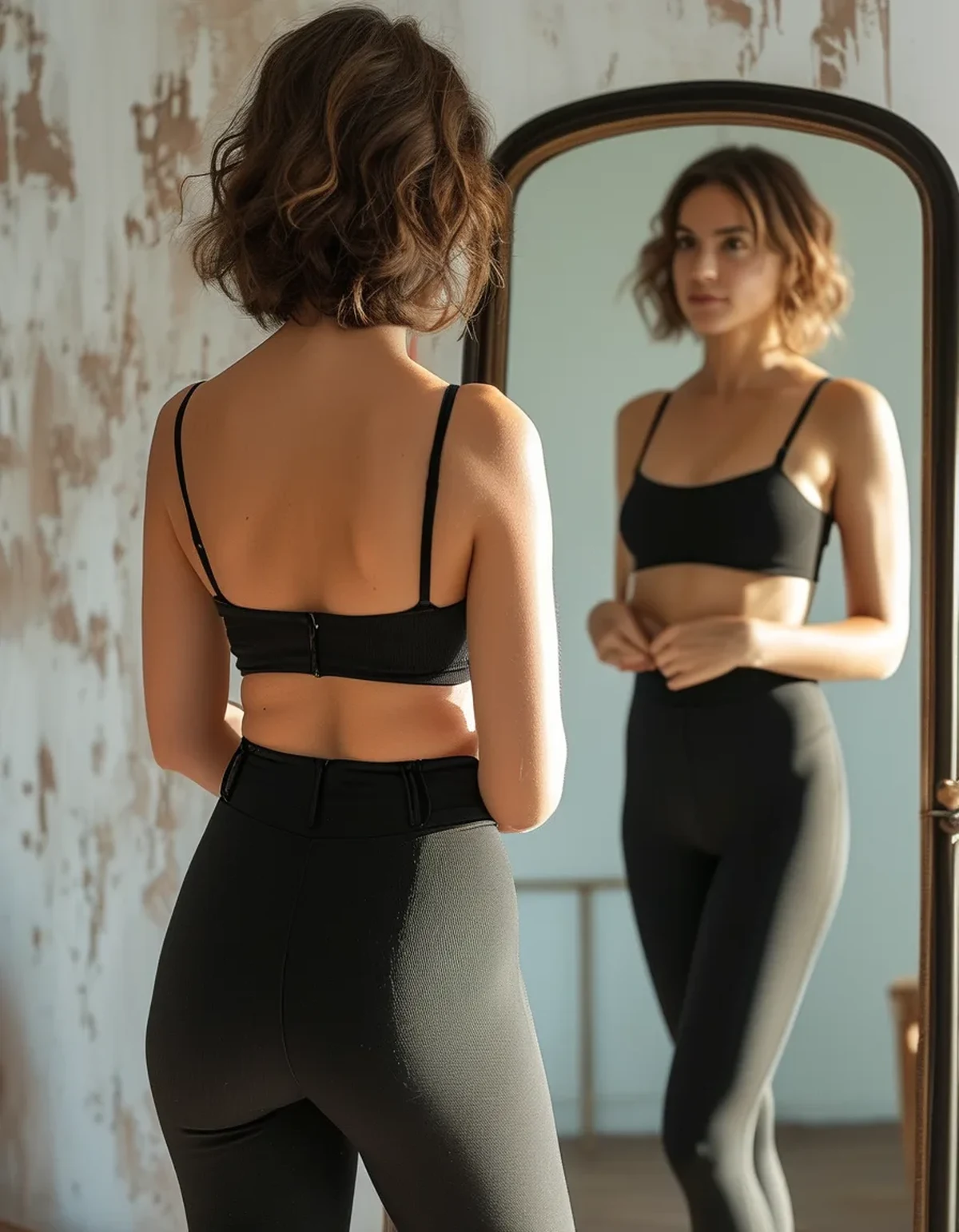
This is one of the clearest cases where a fit problem is about pattern drafting rather than about the wearer.
What is a straight block, and why does it create a gap?
Most mass-market activewear is graded from a single base pattern using a fixed ratio between waist and hip — often around a 9 to 10 inch difference — held constant across every size. Size up and both measurements grow, but the relationship between them never changes.
If your own waist-to-hip difference is 12 or 14 inches, no size on that block matches you. Choosing for the hip gives you the right leg and seat fit with several inches of surplus at the waist, and surplus fabric on a curved surface collects at the deepest point of the curve — the small of the back. That’s the gap.
Why does the gap always appear at the back specifically?
Because that’s where the body curves inward most sharply. The waistband is a fixed circumference, but your torso’s cross-section at that height isn’t a circle — it’s flatter at the front and sides and scoops in at the lumbar curve.
Excess circumference has to go somewhere, and it collects where the body pulls furthest away from the band’s path. This is also why the gap tends to get worse when you bend forward: the lumbar curve deepens in flexion, which increases the distance the band has to span. A gap that’s minor standing and dramatic in a hinge is the classic signature of this problem.
How do you identify a curve-graded pair before buying?
Three signals are reliable. A brand publishing separate waist and hip measurements for each size — rather than a single ‘fits sizes 6-8’ range — is drafting with more precision, which usually means a better-graded block.
A contoured waistband that’s cut with a curve rather than as a straight rectangle is a direct structural fix, since the band is shaped to follow the lumbar curve instead of spanning it. And a center-back seam or a V-shaped back panel almost always indicates the pattern accounts for the curve. Flat, seamless rectangular bands are the most likely to gap on a high waist-to-hip ratio.

Does the fabric’s compression level change anything?
It changes how the gap presents rather than whether it exists. A high-compression fabric pulls the excess in tighter, so the gap becomes a smaller pocket rather than a visible opening — but the surplus circumference is still there, and it usually shows up as a slight fold or roll instead.
Lower-compression fabric shows the gap more honestly but is often more comfortable, since high compression on an already-mismatched pattern concentrates pressure at the hip where the band is doing all its work. The real point is that compression is compensating for a drafting mismatch, and compensation has a comfort cost.
5 Mistakes People Make With Waist Gap
1. Sizing down to close the gap. This trades a cosmetic issue for a genuine one — hip and thigh compression that causes sheerness and discomfort.
2. Assuming it’s a body problem. A larger waist-to-hip difference is a common proportion, not a deviation. The pattern is what’s fixed and narrow.
3. Buying by dress size instead of measurements. Dress sizing hides the ratio entirely, which is the one number that matters here.
4. Ignoring the back seam. A center-back seam or shaped panel is the single strongest indicator of curve-aware drafting.
5. Layering a longer top and calling it solved. It hides the gap but the band still slides, because surplus circumference means less grip.
FAQ: Waist Gap Questions, Answered
Can a tailor take in a legging waistband?
Yes, and it’s one of the more successful activewear alterations — a small dart or a taken-in center back can remove two or three inches cleanly if the band isn’t fully bonded.
Does the gap mean the leggings will slide down?
Often, yes. Surplus circumference means less contact and less grip, so gapping pairs migrate more than well-fitted ones.
Do crossover waistbands help with waist gap?
They do help, because the overlapping panels can accommodate a wider range of ratios than a fixed rectangular band.
TL;DR:
- Waist gap comes from straight-block grading that holds a fixed waist-to-hip ratio across sizes
- Excess circumference collects at the lumbar curve, which is why it always shows at the back
- Look for published waist AND hip measurements, a contoured band, or a center-back seam
- Sizing down trades a cosmetic gap for real compression problems at the hip
The gap is a drafting mismatch, full stop. Shopping for curve-graded patterns solves it in a way that changing sizes never will.
See It in Motion
Seen here: High Waist Embossed Yoga Leggings with Side Pockets — shop it on bubblelime.com
Keep Reading
This article is for general informational and styling purposes only. Fit, sizing, and product availability may vary.