Why Workout Tanks Ride Up on a Curvy Frame — and the Length Rule That Fixes It
Quick Answer: Tanks ride up on curvy frames because the hem circumference is smaller than your hip circumference, so the fabric climbs to the narrowest place it can sit. The fix is not a longer tank — it is a tank with a hem that is wider than your hip measurement, or a hem shaped with a slight A-line. Straight-cut hems will always climb.
You pull the tank down, do a set, and it is back around your waist. You pull it down again. By the end of the session you have adjusted it thirty times and you have decided the brand runs short.
The brand probably does not run short. The hem is the wrong shape.
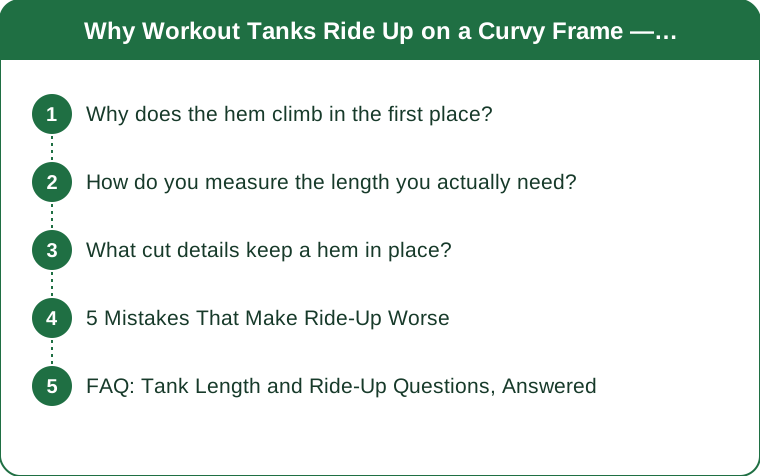
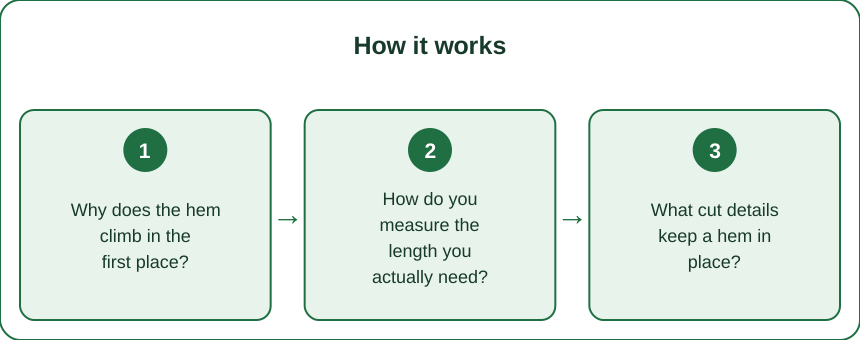
Why does the hem climb in the first place?
Fabric under tension moves towards the position of least tension. That is the entire mechanism.
If a tank hem measures 38 inches around and your hip measures 44, the hem is stretched by six inches when it sits at your hip. Every movement gives it an opportunity to escape that tension, and the nearest place with less tension is upward, at your waist. So it goes there, and it stays there, because that is where it fits.
This is why the standard advice — buy a longer tank — so often fails. A longer tank in the same straight cut has the same hem circumference and simply has further to travel. It rides up to the same place, just with more fabric bunched there.
The number that matters is not length. It is hem circumference relative to your hip. For a hem to stay put, it needs to be at or slightly above your hip measurement, so it is not being asked to stretch at all where it sits.
This affects curvier frames disproportionately for an obvious structural reason: the difference between waist and hip is larger, so the distance the hem can climb before it finds a comfortable resting place is longer and the tension driving it is higher.
How do you measure the length you actually need?
Two measurements, taken once, that will save you a lot of returns.
Measurement 1: your hip circumference at the widest point. Not at the hip bone — at the fullest part, which for many people is 7 to 9 inches below the natural waist. Write it down.
Measurement 2: the vertical distance from your shoulder point to where you want the hem to sit. Run the tape from the top of your shoulder, down the front over the bust, to the target hem. For most people wanting hip coverage this lands between 26 and 30 inches.
Now compare against product listings. Good brands publish both a length measurement and a hem or sweep measurement. If the sweep is smaller than your hip measurement, that tank will ride up on you regardless of its length. If the sweep is at or above your hip measurement plus an inch or two, it will sit.
When a brand only publishes length, you can often infer the hem shape from the product photo — look at whether the silhouette narrows, stays parallel, or flares slightly from bust to hem. Parallel or narrowing is the problem shape.
What cut details keep a hem in place?
Four things, roughly in order of effectiveness.
A-line or slight flare. Even a modest flare — an inch or two more at the hem than at the bust — removes the tension entirely. This is why boxier tanks stay put and fitted ones do not, and it has nothing to do with how snug they look at the top.
Side splits. A vent of two to three inches at the side seam gives the hem somewhere to open rather than climb. It is the cheapest possible fix and it works well.
A curved or high-low hem. A hem that dips at the back and sides distributes the circumference where the body is widest, which is essentially a flare in disguise. High-low hems get treated as a style choice; on curvier frames they are a functional one.
A weighted or banded hem. A slightly heavier finish — a doubled band, a raw-edge roll — adds a little mass at the bottom. It sounds trivial. It measurably reduces creeping, because the hem now has enough weight to resist the small upward pulls from arm movement.
What does not work: a ribbed elastic hem that grips. Grip hems on a tank that is too narrow at the sweep just grip you in the wrong place, and they tend to leave a visible line.
5 Mistakes That Make Ride-Up Worse
1. Sizing up for length. Sizing up adds length and circumference proportionally, which usually means a gaping armhole and a loose bust before it adds enough sweep to fix the problem. Buy for the sweep, not the size number.
2. Tucking the tank into high-waisted leggings and calling it solved. It works until you raise your arms. A tuck holds a hem that is already close to fitting; it cannot hold one that is six inches too narrow.
3. Choosing a heavy cotton blend hoping the weight holds it down. Cotton blends stretch out with sweat and stay stretched, so the hem that was tight at the start of the session is loose and shapeless by the end — but it has already climbed.
4. Assuming it is a bra band problem. Sometimes the tank is not riding up, it is being pushed up by a sports bra band that is rolling. Check whether the tank hem is climbing on its own or whether everything above it is shifting down.
5. Buying cropped and layering underneath. This one surprises people, because it seems like a workaround rather than a mistake. But two layers of fitted fabric at the waist create friction between them, and friction is what converts arm movement into hem movement. A single well-cut layer stays put better than two.
FAQ: Tank Length and Ride-Up Questions, Answered
Is a longline tank the same as a longer tank?
Usually not. Longline generally means the cut is drafted longer with the sweep adjusted accordingly, which is what you want. A regular tank in a tall size is often just a longer version of the same narrow hem.
Does fabric weight matter?
Somewhat. A mid-weight knit resists creeping better than a lightweight jersey, mainly because it has more mass and less stretch. But hem shape beats fabric weight — a light A-line hem stays put better than a heavy straight one.
Why do some tanks ride up only during certain exercises?
Overhead movement is the main culprit, because raising your arms lifts the shoulder seam and the whole garment follows. Rowing motions and anything with a hinge at the hip also contribute. If your tank behaves during lower body work and misbehaves during upper body work, the shoulder seam is doing it, not the hem.
Can a tailor fix this?
Adding side splits is a genuinely easy alteration and cheap. Adding sweep is not — there is nothing to let out. If you have a tank you love that rides up, splits are worth the ten dollars.
Does this change in hot weather?
Yes. Damp fabric grips skin, and grip against a moving body means the hem gets dragged upward with every rep. Ride-up complaints spike in humid late-summer training for exactly this reason, and improve as the weather cools.
TL;DR:
- Tanks ride up because the hem circumference is smaller than your hip, not because the tank is short.
- Measure your hip at the fullest point and compare it to the brand’s published sweep — the sweep should be at or above it.
- Look for A-line cuts, side splits or curved hems; avoid straight parallel silhouettes and gripping elastic hems.
- Sizing up rarely fixes it, and layering under a crop often makes it worse.
Once you start reading sweep measurements instead of size labels, the problem more or less stops happening. It is one of the few fit issues where a single number tells you the answer before you ever try the garment on.
See It in Motion
Seen here: Racerback Tank Top - White — shop similar styles on bubblelime.com
Keep Reading
This article is for general informational and styling purposes only. Fit, sizing, and product availability may vary.