Curvy Fit Leggings That Do Not Gap When You Sit Down
Quick Answer: Sitting is a completely different fit test from standing. When you sit, the distance from your waist to your seat over the back of the body increases by several centimetres, and if the rise is not long enough, the waistband is pulled down at the back to make up the difference. The standing gap and the sitting gap have different causes: standing gap is a waist-to-hip ratio issue, sitting gap is a back rise length issue. Look for a long back rise, a contoured or curved waistband that is higher at the back than the front, and a wide band with real grip. And test every pair seated for at least a minute before removing the tags.
The changing room mirror only ever shows you standing. Almost nobody sits down in a fitting room.

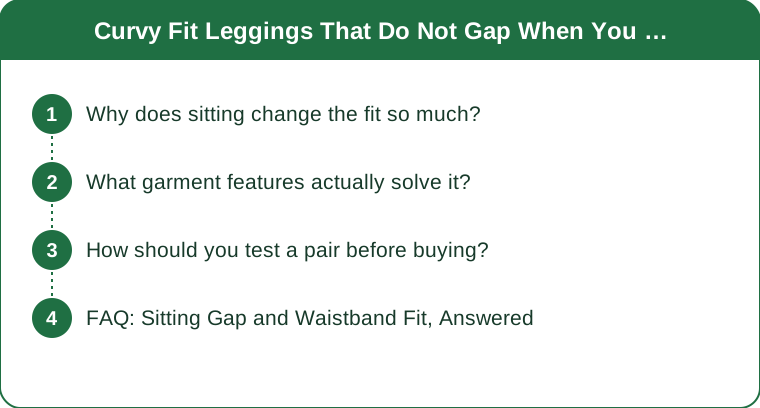
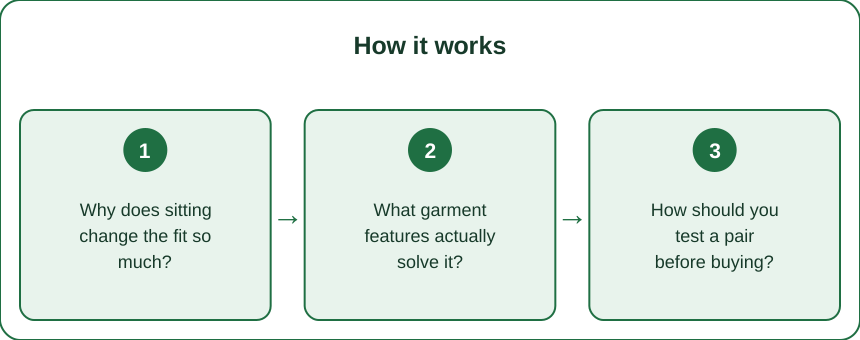
Why does sitting change the fit so much?
Because the geometry of your body changes, and the garment has to find the extra length from somewhere.
Standing, your torso is straight and the distance from your waistband, over the seat, to the crotch seam is one measurement. Sitting, your hip is flexed to 90 degrees, and the path over the back of the body from waist to seat becomes noticeably longer - typically several centimetres more than standing.
Leggings do not create length; they borrow it. The fabric will stretch some, but stretch fabric under tension pulls from the direction of least resistance, and that direction is downward at the waistband. So the band descends at the back, and you get a gap.
Why a curvy fit is more affected:
- A larger difference between waist and hip means more curve to travel over, so the sitting increase is greater.
- Standard patterns grade the back rise less than they grade the hip. As sizes increase, the hip gets much bigger and the back rise gets slightly longer, so the ratio worsens.
- The waistband sits on a smaller circumference than the hip, so any downward force meets less resistance - it slides down toward a wider part of the body and then stays there.
Two different problems that get confused:
- The standing gap - a horizontal gap at the small of the back while standing straight. This is a waist-to-hip ratio issue: the waistband is sized for a waist much larger relative to the hip than yours.
- The sitting gap - the band descends when you sit. This is a rise length issue, and it happens even in leggings that fit perfectly standing.
They need different fixes, which is why people who correctly identify a gap and buy a smaller waist size are frustrated when the sitting version continues. A tighter waistband on a short rise just means more force pulling on a smaller area.
What garment features actually solve it?
In order of how much difference they make.
1. A long back rise, ideally a contoured waistband. The best construction has a waistband that is cut higher at the back than at the front - often 2 to 4cm higher - following the body’s actual shape rather than sitting on a flat horizontal line. This is the single most effective feature and it is what dedicated curvy-fit ranges usually get right. Look for descriptions mentioning a contoured, curved, or dipped waistband.
2. A genuinely high rise. The higher the band sits above the point where the curve begins, the more anchoring it has. A high-rise band on a natural waist has the ribcage to sit against; a mid-rise band has nothing but a slope.
3. A wide waistband, 10cm or more. Width spreads the tension over a larger area, resists rolling, and is far harder to displace than a narrow band. Rolling and sliding are the same failure at different stages - narrow bands roll first, then slide.
4. Grip on the inside of the band. Silicone strips, a brushed inner surface, or a textured tape. Modest on its own, effective in combination.
5. Fabric with real recovery. Stretch the band and release it. If it returns instantly and firmly, it will hold; if it recovers slowly, it will migrate within an hour of sitting. This one test in a shop predicts more than any label.
6. A drawstring. Increasingly rare in leggings, and genuinely useful because it lets you set waist tension independently of hip fit.
7. Seam structure at the back. A centre back seam with a slight curve, or a V-shaped yoke, adds shaping that a flat panel cannot. It also gives a place to take in later if needed.
Features that do not solve it: a tighter overall size, a thicker but shorter band, or compression alone. Compression addresses circumference; this is a length problem.

How should you test a pair before buying?
The standing mirror check is close to useless for this. Five tests, three minutes.
1. The sit test - the important one. Sit down fully on a chair or the fitting room bench, feet flat, back straight. Hold it for at least 60 seconds, because migration is progressive rather than instant. Then reach behind and feel where the band is. If you can fit a hand into a gap, the rise is too short.
2. The sit-and-lean test. Sitting, lean forward as if reaching for something on the floor. This is the maximum-demand position and it is what happens every time you pick something up at a desk. If the band comes away here, it will do it several times a day.
3. The squat and stand cycle. Squat down and stand up five times, then check the band without adjusting it. Repeated cycling is what reveals fabric that creeps.
4. The recovery pinch. Pull the waistband away from your body about 5cm and let go. It should snap back. A slow return means it will not hold through a day.
5. The roll check. After the above, look at whether the top edge has begun to fold over on itself. Rolling is the early warning for sliding, and once a band starts rolling it will not stop.
If you already own leggings that do this:
- Wear them for shorter, more active periods rather than long seated ones. The failure is specific to sustained sitting.
- A longline top or a slightly longer sports bra covers the gap without solving it, which is a reasonable compromise for a pair you otherwise like.
- Alterations are possible but limited - taking in a waistband on a knit is fiddly and can affect the stretch, though a tailor who works with stretch fabric can sometimes add a shaped panel at the centre back.
- Accept a pair as gym-only rather than trying to make it work for a desk day.
When buying online, look for brands that publish a rise measurement in centimetres rather than only a rise description, and compare the front and back rise if both are given. A brand that lists them separately usually does so because there is a meaningful difference, which is a good sign.
FAQ: Sitting Gap and Waistband Fit, Answered
Should I size up or size down?
Neither, usually - it is a rise problem rather than a circumference problem. Sizing down tightens the band and increases the force pulling it down; sizing up loses grip. Change the style, not the size.
Do curvy fit ranges actually differ or is it marketing?
Genuine curvy fit ranges are graded on a different waist-to-hip ratio and usually have a longer, contoured back rise. Check whether the brand says what is different - if the description mentions a specific ratio or a contoured waistband, it is likely real. If it only says designed for curves, it may just be the same block in larger sizes.
Why do my leggings roll down at the top?
Rolling happens when the band is under tension from below and has nothing anchoring the top edge. It is usually the first stage of the same problem, and a wider band with better recovery is the fix.
Is this different from the standing waist gap?
Yes, and they need different solutions. Standing gap is about waist-to-hip ratio and is fixed by a curvy-graded pattern. Sitting gap is about back rise length and is fixed by a contoured, higher-at-the-back waistband.
Will a longer top just solve it?
It hides it, which is a perfectly reasonable answer if you like the leggings. It does not stop the band migrating, so the fit will still feel wrong even if it looks fine.
Does this happen with all fabrics equally?
No. Soft, lightweight, buttery fabrics migrate most because they stretch easily and recover slowly. Firmer compressive fabrics hold considerably better, which is a genuine trade-off against comfort.
TL;DR:
- Sitting lengthens the path from waist to seat by several centimetres - and if the rise is too short, the waistband descends to supply it.
- Standing gap is a waist-to-hip ratio problem. Sitting gap is a back rise length problem. They need different fixes.
- Look for a contoured waistband cut higher at the back, a genuinely high rise, and a band 10cm or wider with fast recovery.
- Do not size down. A tighter band on a short rise just pulls harder on a smaller area.
- Test seated for a full minute, then lean forward - migration is progressive, and the standing mirror will never show it.
Nobody sits down in a fitting room, which is exactly why this keeps happening. Sit down, wait, then decide.
See It in Motion
Seen here: Super High Waist Embossed Yoga Leggings with Inner Pocket — shop it on bubblelime.com
Keep Reading
This article is for general informational and styling purposes only. Fit, sizing, and product availability may vary.