The Jacket Problem: When the Shoulders Fit but Nothing Else Does
Quick Answer: Three points determine jacket fit - the shoulder seam, the bust circumference, and the sleeve bicep. Shoulder seam position cannot be altered without reconstructing the garment, so it is the one to prioritise; bust and sleeve can be adjusted or worked around. For curvy proportions the usual failure is buying up for the bust, which leaves shoulder seams sitting down the arm and makes the whole jacket look borrowed.
Everything else in the activewear drawer stretches. Jackets do not, or not enough, and they are the piece where standard sizing and curvy proportions diverge most obviously. The zip pulls, the shoulders drop, and sizing up fixes one problem while creating two.
Why do jackets fit so differently from everything else?
Because they are structured garments graded on assumptions your body may not match.
Most activewear is knit and forgiving. A legging or a tee stretches in every direction and accommodates a wide range of body shapes at any given size. A jacket has a set-in or raglan sleeve, a front opening, and often woven or bonded panels, all of which constrain fit at specific points.
Grading assumes proportions change together. As sizes increase, patterns typically increase bust, shoulder, sleeve, and length in a fixed ratio. That works when a body scales proportionally. It does not when bust circumference is significantly larger relative to shoulder width - which is exactly the common curvy pattern.
So sizing up to clear the bust also adds shoulder width, sleeve length, and back width you did not need. The result is a jacket that closes comfortably and sits wrong everywhere else: shoulder seam halfway down the arm, sleeves too long, excess fabric across the back.
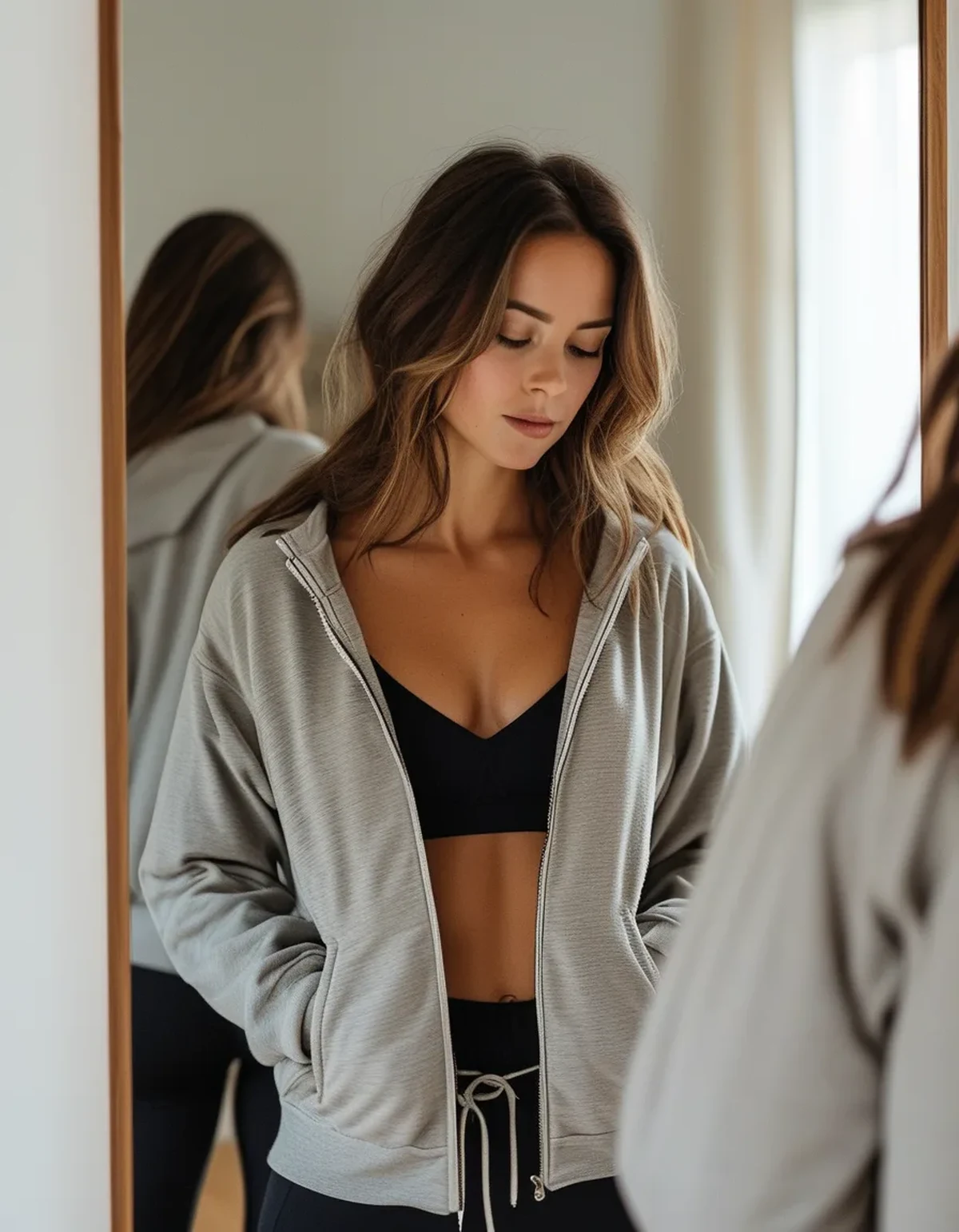
The front opening makes bust fit visible in a way tops do not. A pullover distributes strain invisibly. A zip shows exactly where the garment is short of fabric, because the zip line pulls sideways and the horizontal drag lines point straight at the tight spot.
And the shoulder is the one you cannot fix. A tailor can take in a back, shorten a sleeve, add a gusset. Moving a shoulder seam means dismantling and rebuilding the top of the garment, which costs more than the jacket.
What do the drag lines actually tell you?
The wrinkles are diagnostic, and they point at the problem rather than away from it.
Horizontal lines pulling from the zip outward at bust level: the jacket is too small in bust circumference at that point. This is the most common curvy fit failure, and it is genuinely a size issue at that measurement - not something styling fixes.
Diagonal lines running from the bust up towards the shoulder: the garment lacks vertical length over the bust. It needs more fabric front length, which is a pattern issue rather than a size issue. Sizing up sometimes helps and often does not, because grading adds circumference faster than it adds front length.
A shoulder seam sitting past the edge of your shoulder: the jacket is too wide at the shoulder for you, generally because it was sized up for the bust. Everything about the jacket will read oversized from this point on.
Excess fabric pooling at the lower back: the back is longer or wider than needed, usually another symptom of sizing up.
Sleeves that pull at the bicep while the body is fine: an independent measurement that varies substantially between brands and is frequently the actual limiting factor. Bicep circumference is rarely listed on size charts, which makes it the most common unexpected failure.
Read them in this order: shoulder seam first, then bust, then sleeve. The shoulder decides whether the jacket can ever work; the others decide how much work it needs.

Which jacket styles actually work?
Some constructions are far more accommodating of a bust-to-shoulder difference than others.
Works well:
- Raglan sleeves. The diagonal seam from underarm to neckline has no fixed shoulder point, so it accommodates a much wider range of shoulder widths. This is the single most useful thing to look for.
- Drop-shoulder and oversized cuts, where the shoulder is intentionally past the natural point so there is no correct position to miss.
- Princess seams or vertical panel seams through the front. These add shaping over the bust without adding overall width, and they are the structural solution to the exact problem.
- Stretch-woven or bonded knit fabric with genuine four-way stretch, which forgives circumference differences that a rigid woven cannot.
- Half-zip and pullover styles, which remove the front-opening strain point entirely.
Works poorly:
- Structured set-in sleeves in rigid woven fabric, particularly with a defined shoulder pad or a firm armhole.
- Cropped jackets that end at the fullest part of the bust, which puts the hem where the circumference is greatest and makes it flare outward.
- Anything with a horizontal seam or a pocket line across the bust.
- Very fitted, minimal-ease running shells.
And a note on the crop question: a jacket that ends either above the bust or clearly below the widest point works. One that ends at the widest point will always flare, regardless of size.
What Nobody Tells You About Jacket Fit
The bicep is a separate measurement and it is rarely published. Two jackets with identical bust measurements can differ by several centimetres at the bicep. If you have found jackets pull at the upper arm before, measure a jacket you own that works and ask brands directly - many will provide flat measurements that are not on the size chart.
Zip length affects perceived fit more than the fit itself. A jacket worn half-zipped changes where the eye reads tension. If a jacket is genuinely comfortable but shows slight drag lines fully closed, wearing it partly open is a legitimate answer rather than a compromise.
Shoulder fit is what makes a jacket look expensive. More than fabric, more than brand. A correctly seated shoulder seam on a cheap jacket reads better than a dropped seam on an expensive one, which is why prioritising it is not a fussy detail.
Taking in a back is a genuinely cheap alteration. If a jacket fits the bust and shoulder but has excess across the back, a tailor can take a vertical wedge out of the centre back or side seams for a modest cost. This is the single highest-value alteration in the category and almost nobody does it.
Layering thickness changes everything and gets forgotten in fitting rooms. A jacket tried on over a thin tee in August will be worn over a sweatshirt in November. Try it over the thickest thing you will realistically wear underneath, particularly now, when the layer you are testing over is the thinnest one of the year.
FAQ: Curvy Jacket Fit Questions, Answered
Should I size up in a jacket to fit my bust?
Only if the shoulder still sits correctly at the larger size. If sizing up drops the shoulder seam past the edge of your shoulder, the jacket will read oversized everywhere and a different style - raglan, princess seam, or stretch-woven - is the better route.
Why do jackets pull across my chest when tops do not?
Knit tops stretch in all directions and distribute strain invisibly. A jacket has a rigid front opening, so any shortfall in bust circumference shows as horizontal drag from the zip. The front opening makes the same fit issue visible.
What jacket style is best for a larger bust?
Raglan sleeves with princess or vertical panel seaming through the front, in a fabric with real stretch. Raglan removes the fixed shoulder point and vertical seams add bust shaping without adding overall width.
Can a jacket be altered to fit better?
Back width, sleeve length, and hem length are all straightforward and inexpensive. Bust circumference can sometimes be let out slightly if there is seam allowance. Shoulder seam position effectively cannot be moved without rebuilding the garment - which is why it is the measurement to get right at purchase.
TL;DR:
- Shoulder seam position is the one thing that cannot be fixed - prioritise it over everything.
- Sizing up for the bust adds shoulder, sleeve, and back width you did not need.
- Raglan sleeves, princess seams, and real stretch fabric solve the proportional mismatch structurally.
- Bicep circumference is a separate measurement and is rarely published - ask.
- Taking in the back is cheap and transforms a jacket that fits the bust but nothing else.
Buy for the shoulder, adjust everything else. It is the one measurement where the garment gets a vote and you do not.
Keep Reading
This article is for general informational and styling purposes only. Fit, sizing, and product availability may vary.